 Digital Art Museum Tokyo
teamLab Planets TOKYO DMM, Toyosu
teamLab Planets is the teamLab museum in Toyosu where you take your shoes off at the door and walk through the artworks in water that reaches knee height. It holds the best-selling digital art listing in Tokyo, rated 4.6 from 13,437 verified reviews, and its published run ends at the end of 2027.
About teamLab Planets TOKYO
JPY 3,600 Entrance Pass, dynamically priced, tax included
8:00 to 22:00, last entry one hour before closing
Toyosu 6-1-16, Koto-ku - 1 minute from Shin-Toyosu Station
Barefoot throughout; levels rise to knee height on adults
4.6 from 13,437 verified reviews on GetYourGuide
Entry only within 30 minutes of your slot, and no refunds if you miss it
Listing at a Glance
The same fields as every other page here, read from the museum's own pages and the listing in August 2026. Prices are dynamic and are confirmed at checkout on the seller's site.
- Museum teamLab Planets TOKYO DMM
- Ticket seller LINKTIVITY Inc., as an official ticket
- Booking platform GetYourGuide
- Product ID 260407
- Starting price $22.63 USD
- Museum price, adults 18+ JPY 3,600 Entrance Pass, dynamic
- Junior / senior high JPY 2,800
- Children 4-12 JPY 1,500
- Under 4 Free
- Disability certificate JPY 1,800
- Premium Pass JPY 12,000, no fixed time, priority entry
- Price last checked August 2026
- Rating 4.6 out of 5
- Review count 13,437 reviews
- Review source GetYourGuide verified bookings
- Entry windows 08:00-12:00, 12:30-16:00, 16:30-18:30, 19:00-20:00, 20:30
- Entry grace First 30 minutes after the selected time only
- Time inside No limit once admitted
- Typical visit About 90 minutes to two hours
- Closed days Thu 3 September, Thu 1 October in 2026
- Nearest station Shin-Toyosu, Yurikamome Line, north exit, 1 minute
- Transport included No
- Guide Self-guided; no live guide
- Shoes Off - barefoot, and socks or stockings off too
- Water Up to knee height, chlorinated, not for swimming
- Clothing Free rental shorts XS-6L for mirrored floors; free rental shoes
- Food inside Vegan Ramen UZU, 10:30-21:30, only after admission
- Cancellation Non-refundable, including for late arrival
- Same-day tickets Not sold on this listing
- ID required Passport or ID card; checked for age and student tickets
- Minimum age Under-13s must be accompanied; one adult per three children
- Difficulty Easy walking, barefoot on wet and mirrored floors
- Wheelchair Listed as not suitable for wheelchair users
- Health notes Not suitable with heart conditions or epilepsy; one area has strong flashing light
- Re-entry Not permitted
- Weather Indoor, but the Open-Air works close in heavy rain or typhoon winds
- Alternative teamLab Borderless at Azabudai Hills
Check Dates and Entry Times
Live entry slots straight from the booking platform. Same-day tickets are not sold on this listing, so the earliest date you will see is tomorrow.
Looking at Borderless instead? Borderless & Imperial Palace · Borderless & Roppongi Hills · teamLab Borderless ticket
Quick answer Tickets, the water rules and how long it takes
teamLab Planets TOKYO DMM is the Toyosu half of teamLab's Tokyo pair, and it is the physical one: shoes and socks come off at the lockers, and the water in the artworks rises to knee height on an adult. The adult Entrance Pass is JPY 3,600 on dynamic pricing; the platform ticket sits around $23 and holds 13,437 verified reviews at 4.6. The rule that catches people out is entry - you can only go in within 30 minutes of the time on your voucher, and there is no refund if you miss it. If you would rather keep your shoes on, that is teamLab Borderless.
Key takeaways
- Wear something that rolls above the knee - wet clothes are not allowed into the next artwork
- Comparing what is bookable? The digital art museum tickets and tours sit side by side on one page
- Mirrored floors mean the museum lends free shorts in XS to 6L, and free shoes if yours have no heel support
- Most visits run 90 minutes to two hours, though there is no time limit once you are in
- The Premium Pass at JPY 12,000 is the only priority-entry product either teamLab museum sells
- Planets runs until the end of 2027 - a date already pushed back twice
- Comparing the two museums? Planets or Borderless sets out what actually differs
What teamLab Planets TOKYO Is
A museum you enter with your body rather than walk around.
The name and the place
The full name is teamLab Planets TOKYO DMM, and it sits at Toyosu 6-1-16 in Koto City, on reclaimed land beside Tokyo Bay. The DMM in the title is the company that co-produces it, which is why searches for "teamLab Planets TOKYO DMM" and for "teamLab Planets" land on the same building.
It opened on 7 July 2018. The relationship with teamLab Borderless confuses almost everyone: same collective, two entirely separate museums, about 9 km apart. Borderless is at Azabudai Hills in central Minato City and is permanent. Planets is out at Toyosu and has a published end date.
The short version of what makes Planets different: at Borderless the art is around you. At Planets you are standing in it, barefoot, in water.
Immersion, taken literally
The museum describes itself as a place where you "become one with the art" using your entire body, and unlike most such claims this one has physical consequences you need to plan for.
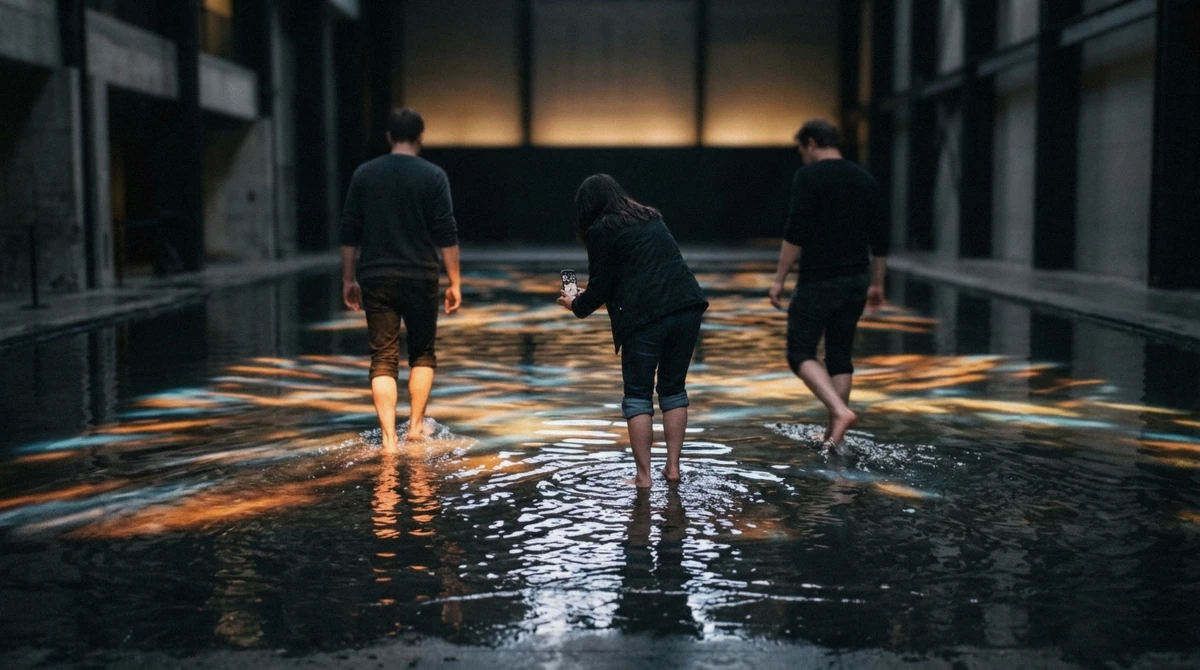
You take off your shoes at the locker area. You take off socks or stockings too, because several works involve water. In those rooms the water rises to knee height even on an adult - it is chlorinated with sodium hypochlorite to regulated levels, and the museum is explicit that it is not a swimming pool.
Unlike Borderless, Planets has a fixed route through clearly delineated spaces. You walk it in order. That makes it far more predictable to plan around, and it is the reason a visit here compresses into a couple of hours where a Borderless visit stretches.
teamLab Planets Tickets and the 30-Minute Rule
Two products, one deadline that costs people their money.
Entrance Pass prices
The Entrance Pass carries a fixed admission time and is priced dynamically, tax included:
- Adults 18 and over: JPY 3,600 - Junior and senior high school students: JPY 2,800 - Children 4 to 12: JPY 1,500 - Children 3 and under: free - Holders of a disability certificate: JPY 1,800
ID is checked. Bring a passport or ID card, and expect to prove age or school affiliation if you booked a student rate.
The Premium Pass, and whether it is worth JPY 12,000
The Premium Pass costs JPY 12,000 for anyone aged 4 and over. It removes the fixed entry time and gives priority entry.
That is more than three times the adult Entrance Pass, and what it buys is not more art - it is not queueing. Whether that is worth it depends entirely on your date. It is the only product either teamLab museum sells that addresses the complaint reviewers raise most: one traveller from Australia, writing in August 2026, described the entry queue as "very loooong" and said that on a hot, cold or rainy day it tests your physical and mental endurance before the art gets its chance.
For a weekday in a quiet month, save the money. For a Saturday in cherry blossom season or Golden Week, it is the difference between an hour outside and walking in.
The 30-minute entry rule
This is the single most expensive detail on the page. On the platform ticket, entry is only possible within the first 30 minutes after your selected entry time, and there are no refunds for late arrival.
The entry windows are 08:00-12:00, 12:30-16:00, 16:30-18:30, 19:00-20:00 and 20:30. Same-day tickets are not sold on this listing, so this cannot be a plan you make over breakfast.
There is one softening detail, and it comes from the museum rather than the platform: teamLab's own FAQ says that if you arrive later on the same day within opening hours, you can still enter - ask a member of staff at the venue. Treat that as the museum's goodwill, not as a refund policy you can rely on.
Changes, refunds and resale
Tickets cannot be cancelled or refunded once purchased. Bought on the museum's own website, a ticket's date and time can be changed up to two hours before the admission time; bought anywhere else, the seller's terms apply.
Resale is banned outright. A ticket bought through a resale channel will not get you in, and the museum states plainly that it takes no responsibility for anyone turned away with one. If a resale price looks better than the museum's, that is why.
And the rule that applies to both teamLab museums: re-entry is not permitted, and no refund is given once you have entered.
Barefoot, Wet, and What to Wear
No other museum in Tokyo has a dress code with this much riding on it.
What comes off, and how deep it gets
Shoes come off at the locker area. Socks and stockings come off too - the water works are entered with bare feet, and there is no way around it.
Water levels rise to knee height even for adults. Not ankle-deep, not a decorative film across a floor: knee height. The museum chlorinates it with sodium hypochlorite to regulated standards and states it is not for swimming.
So: trousers that roll above the knee, shorts, or a skirt above the knee. Skinny jeans do not roll and you will be wading in them. Lockers are provided for small items.
The wet-clothes rule
Here is the part visitors discover too late. Wet clothes are not allowed into the next artwork. For safety reasons, staff will stop you and ask you to change.
If you have nothing to change into, towels can be rented and you dry off - which means standing in a corridor drying yourself while the visit waits. Bring a spare set for small children, or dress them in something nobody minds getting wet. The museum says exactly this in its own notes.
This is also the strongest practical argument for choosing an early or late slot in cold weather: you walk out of a heated building into a Tokyo February evening with damp legs either way, but at 20:30 you are heading straight home.
Mirrored floors and the free shorts nobody mentions
Several rooms have mirrored floors. The museum lends shorts for free, in sizes XS to 6L, along with wraps, precisely for this, and you return them on the way out. If you are in a skirt or a dress, this is the answer, it costs nothing, and it is not offered automatically - you have to ask a member of staff.
Footwear matters too, in the parts where shoes are back on: some artworks cannot be experienced in heels or in sandals without heel support, and free rental shoes are available.
Two more things the museum flags: one area has strong stimulating light, and another is genuinely dark. If either is a problem for anyone in your group, staff can route you around individual works.
The Artworks You Will Walk Through
A fixed route, so these arrive in a sequence rather than at random.
Drawing on the Water Surface Created by the Dance of Koi and People - Infinity
The one that put this museum on every feed. Koi swim across the surface of the water you are standing in, their movement shaped by where people are and by each other. When a koi collides with a person it bursts into flowers and scatters.
The trajectories the fish leave behind draw lines on the water, so the room is a slowly accumulating drawing that you are inside of. The flowers change with the seasons, which means the room in April is not the room in November.
This is the work that makes the barefoot rule non-negotiable, and it is the reason people come.
Floating Flower Garden
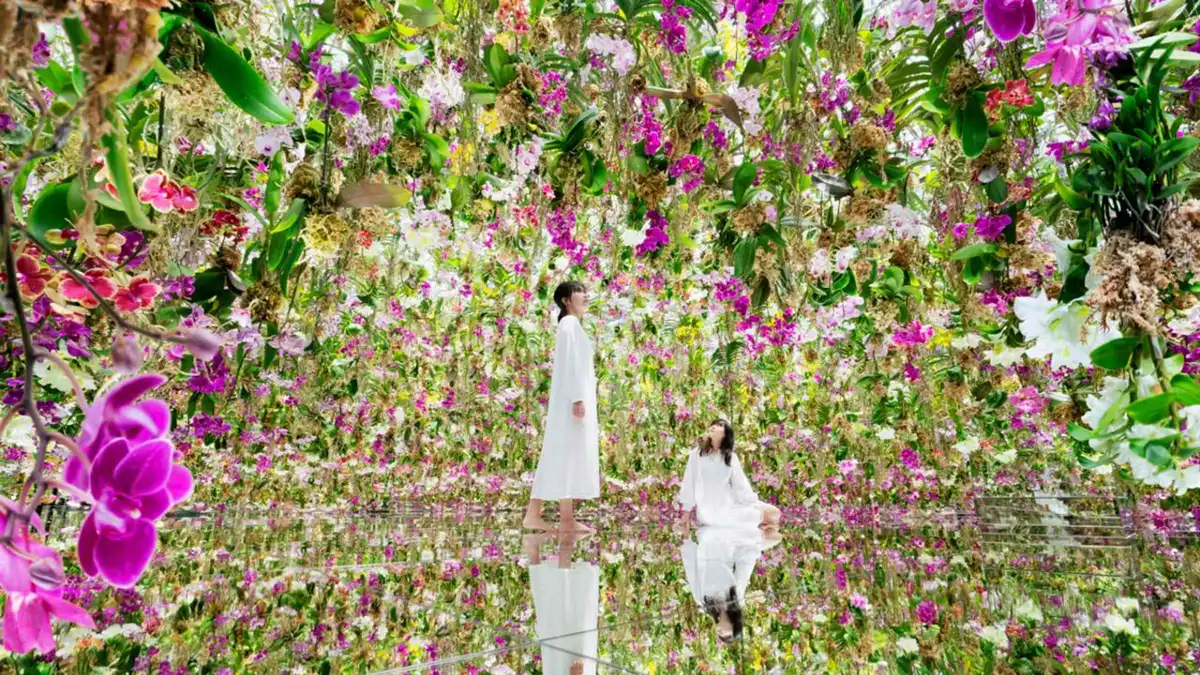
A space filled completely with living orchids - not projections. They hang in a three-dimensional mass, and as you approach, the flowers above you rise, opening a pocket of air so you can move. Walk towards another visitor and your two pockets merge into one space.
The orchids grow without soil, absorbing water from the air, which is how they survive suspended in a room. teamLab's own note on the work is a small essay on why orchids evolved to live on rocks and trees rather than compete for soil - roughly a tenth of all plant species are orchids, precisely because of that adaptation.
The rest of the route
Waterfall of Light Particles at the Top of an Incline sends light down a slope you climb, based on an earlier work made on a real waterfall in the mountains of Shikoku. Light reflects only off the particles, so the falling water becomes a falling curtain of light that leaves afterimages in the dark.
The moss garden works are built around a genuinely strange fact: mosses are poikilohydric, meaning they do not die when they dry out - they shut down and revive when wet. The tardigrades living in the moss do the same thing, entering a state called cryptobiosis where they are neither living nor dead.
There is also a colour work using Kasane no Irome, the layered silk colours of pre-modern Japan, rendered as twelve shades of light, and an Open-Air section outdoors. That last one stays open in light rain but closes in typhoon winds or heavy rain; the rest of the museum carries on regardless.
How Long Does It Take to Walk Through teamLab Planets?
A direct answer, because none of the pages ranking above this one give you one.
Ninety minutes to two hours, and why
Plan on 90 minutes to two hours inside. There is no time limit once you are admitted - the museum does not push you out before the next admission slot - but the route is fixed and finite, which caps the natural length of a visit in a way that Borderless does not.
Add time on either side: the locker area at the start, drying off if you got wetter than planned, and the shop on the way out. If you want to eat at Vegan Ramen UZU inside, add another 45 minutes.
The one thing that stretches a visit unpredictably is the entry queue, which is outside your ticket time and outside your control unless you hold a Premium Pass.
When it is quietest
The museum opens at 8:00, earlier than almost anything else in Tokyo, and the first window is the calmest of the day. The 20:30 slot is the other quiet one - the museum runs to 22:00, so a late entry gives you a thinly populated hour and a half.
At busy times, staff will move visitors along if they have settled in one room for a long stretch. This is stated policy rather than an occasional annoyance, and it is worth knowing if your plan was to sit in the koi room for forty minutes.
The reviews back the timing up: several travellers who booked the 16:30-18:30 window describe taking their time and not feeling rushed.
Hours, Closed Days and Eating Inside
Long opening hours, two closed Thursdays, and a restaurant you cannot reach before your slot.
Opening hours
The museum runs 8:00 to 22:00, with last entry one hour before closing. That makes it one of the longest-open attractions in Tokyo and easy to slot into a day that already has something else in it.
In 2026 it is closed on Thursday 3 September and Thursday 1 October. Those are irregular one-off closures rather than a weekly pattern, so check your date.
The Living Art Store and Sketch Factory run 8:30 to 22:00 - half an hour behind the museum opening, an hour and a half past its last entry.
Vegan Ramen UZU and the Glass House
Vegan Ramen UZU, the Glass House and the Emptiness Table run 10:30 to 21:30. Only light meals and drinks are served between 10:30 and 11:00, and last orders for ramen are 30 minutes before closing.
The catch: these are reachable only after you have been admitted to the museum, and you cannot enter the restaurant before the admission time printed on your ticket. So the plan of eating first and going in afterwards does not work - it is the other way round.
Given that re-entry is not permitted, that makes the meal a decision you take on the way through rather than a break you come back from.
Getting to Toyosu
One minute from a station, and one bus route the museum itself is warning about.
By train and taxi
The museum is at Toyosu 6-1-16, Koto-ku, one minute on foot from the north exit of Shin-Toyosu Station on the Yurikamome Line. It is five minutes from Shijomae Station and Toyosu Market, and ten minutes from Exit 7 of Toyosu Station on the Yurakucho Line.
By taxi it is roughly ten minutes from Ginza and fifteen from Tokyo Station. From Haneda Airport it is about fifteen minutes by expressway.
For perspective, this is the museum's real weakness against Borderless, which sits two minutes from a Hibiya Line exit in central Minato City. One August 2026 reviewer put it directly: Planets is very far from the middle of Tokyo, roughly an hour, and Borderless is much more convenient. They still called the experience awesome and worth the hassle.
The bus to avoid, and the parking perk
The museum currently flags heavy congestion on the To-05-2 Toei bus running from Tokyo Station, Ginza and Tsukiji towards Shin-Toyosu. If a journey planner offers you that bus, take the Yurikamome instead.
If you drive, there is a small weekday perk: show a same-day Planets ticket at Urban Dock LaLaport TOYOSU - the 3F Card Desk or the 1F general information centre - and you get one hour of free parking. The Toyosu Bayside Cross Tower lot is excluded, and the parking ticket is stamped on entry and valid only on the day.
Is teamLab Planets Worth It?
13,437 verified reviews at 4.6 is a large enough sample to say something useful.
What people consistently praise
The recurring note across recent reviews is that it does not feel like a museum. A traveller from the United Kingdom, writing in August 2026, described the combination of digital art, water, mirrors, lights and nature as something completely unlike a typical attraction, and singled out being genuinely part of the artwork rather than looking at it.
The water works and the flower garden get named more than anything else. Families report it working across a wide age range - one visitor from the United States brought teenagers and reported the adults enjoying it as much.
And repeatedly: people say they did not feel rushed, which is a direct consequence of the no-time-limit policy.
What the criticism is actually about
Almost none of it is about the art. Two things come up.
The first is the queue, which is the Premium Pass's entire reason for existing and which is worst in bad weather because you are outside for it. The second is distance - Toyosu is a long way from where most visitors are staying, and there is no getting around the geography.
A third, quieter one is the wet-clothes surprise: people who arrived in the wrong trousers spend part of the visit managing that instead of looking at anything. That is fixable for free, before you leave your hotel, by reading the clothing section.
If you have one afternoon and want the highest chance of a good time, this is still the more predictable of the two teamLab museums - a fixed route, a known length, and the works that made you search in the first place.
teamLab Planets or teamLab Borderless?
Same collective, two museums, and the choice comes down to four practical things.
The four differences
Shoes. Off at Planets, on at Borderless. That single fact drives everything else about how the two visits feel.
Route. Planets has a fixed path through separate rooms; Borderless has no map, no route, and works that move between rooms while you watch.
Location. Planets is in Toyosu on the Yurikamome Line; Borderless is two minutes from Kamiyacho in central Minato City, connected underground.
Time horizon. Planets closes at the end of 2027; Borderless is permanent.
If the photographs that brought you here had water in them, they were taken here. If your group includes anyone for whom bare feet on wet mirrored floors is a problem, book Borderless.
Doing both
It works, but not lazily. Kamiyacho to Shin-Toyosu runs about 35 minutes, and each museum wants two to three hours if you are not rushing.
The order that works is Borderless first, in the morning - it opens at 8:30 and its rooms are calmest early - then Planets later, since it runs to 22:00 and the light outside stops mattering once you are inside. That way, if your clothes end up damp, you are going home rather than to a second museum.
Separate days is better still. Neither museum permits re-entry, so a rushed lap is one you cannot repeat. Both are compared side by side on the digital art museum tickets and tours page.
Is teamLab Planets Closing in 2027?
It has a published end date, and that date has moved twice already.
The dates, in order
teamLab Planets TOKYO opened on 7 July 2018 with a planned run to the end of 2022. That was extended to the end of 2023. It was then extended again, to the end of 2027, which is the date printed on the museum's venue page today.
So the honest reading is: the museum has a stated closing date, it is not imminent, and the precedent is that these dates move. No fourth extension has been announced.
Practically - if you are travelling to Tokyo before the end of 2027, there is no urgency and no reason to pay more for a slot than you need to. If you are planning for 2028, do not build the trip around it until teamLab says something. Borderless has no end date at all and is the safer bet for a distant plan.
Accessibility, Pregnancy and Visiting With Children
This is the museum where the platform listing and the museum's own notes do not quite agree, so both are set out here.
Mobility and health
The GetYourGuide listing states plainly that the experience is not suitable for wheelchair users, nor for people with heart problems or people with epilepsy. The epilepsy warning is concrete: one area of the museum uses strong stimulating light, and another is dark.
The museum's own notes are gentler. They describe detour routes that staff will arrange for visitors with disabilities, or for anyone travelling with children, who wants to skip a particular artwork.
Both can be true at once - a detour exists, but barefoot passage through water across mirrored floors is not level access. If mobility is a factor for anyone in your group, Borderless is the museum built for it: wheelchair loan, accessible escalator, and staff support, with a cap on how many wheelchairs are admitted at a time.
Pregnancy and children
For safety reasons, pregnant visitors are not permitted in some areas. Staff route you around them.
One accompanying adult is required for every three children, counting the under-4s who enter free. The booking listing adds that children under 13 must be accompanied, and unaccompanied minors are not admitted at all.
Infants can come in a front baby carrier. There are diaper tables in the restrooms and a first-aid room available for feeding or resting - a provision Borderless does not have, since it has two rest areas and no nursing room. The museum's advice for small children is the practical one: clothes you do not mind getting wet, or a change of clothes in the bag.
Where teamLab Planets Is
Toyosu, Koto City, one minute from the north exit of Shin-Toyosu Station on the Yurikamome Line.
teamLab Planets TOKYO DMM, Toyosu 6-1-16.
teamLab Planets: Questions Before You Book
How much are teamLab Planets tickets?
The adult Entrance Pass is JPY 3,600 including tax, priced dynamically. Junior and senior high students pay JPY 2,800, children 4-12 pay JPY 1,500, under-4s are free, and disability certificate holders pay JPY 1,800. The Premium Pass, with no fixed entry time and priority entry, is JPY 12,000 for anyone 4 and over. Full breakdown.
How long does it take to walk through teamLab Planets?
Around 90 minutes to two hours for most visitors, with no time limit imposed once you are admitted. Add time for the lockers at the start, drying off if you get wetter than planned, and the shop. Eating at Vegan Ramen UZU adds roughly 45 minutes. More on timing.
What happens if I arrive late for my entry time?
On the platform ticket, entry is only possible within the first 30 minutes after your selected time, and there are no refunds for late arrival. The museum's own FAQ says you can still enter later the same day within opening hours if you speak to staff on site - but that is the museum's goodwill, not the platform's refund policy.
Do I really have to go barefoot?
Yes. Shoes come off at the lockers, and socks or stockings come off too for the water works, where the water reaches knee height on adults. There is no alternative route that keeps you dry. If that does not appeal, teamLab Borderless keeps shoes on and has no water at all.
What should I wear to teamLab Planets?
Something that rolls above the knee, or shorts. Wet clothes are not allowed into the next artwork, so a spare set helps, especially for children - towels can be rented if you have none. For the mirrored floors, the museum lends free shorts in sizes XS to 6L, and free shoes if yours have no heel support. Full clothing guidance.
Is teamLab Planets suitable for young children?
Yes, with rules: one accompanying adult per three children including free-entry under-4s, and under-13s must be accompanied. Infants can enter in a front baby carrier, there are diaper tables and a first-aid room, and staff will route you around any artwork you would rather skip. Bring a change of clothes for anyone small.
Can I buy teamLab Planets tickets on the day?
Not on the platform listing compared here - it does not sell same-day tickets, so book at least the night before. Slots are dated and timed and the popular windows fill first.
Is teamLab Planets closing in 2027?
Its published run ends at the end of 2027. That date has already been extended twice - from 2022, then from 2023 - so another extension is possible but has not been announced. Borderless has no end date. More detail.
Can I take photos at teamLab Planets?
Yes, and the water and flower rooms are the reason most people come with a camera. Flash is banned at both teamLab museums. Bear in mind you are barefoot and often in water, so a wrist strap is worth more here than a tripod - which is banned anyway.
Is there anywhere to eat inside?
Vegan Ramen UZU, the Glass House and the Emptiness Table run 10:30 to 21:30, with light meals only until 11:00 and last ramen orders 30 minutes before closing. You can only reach them after admission and not before the time on your ticket, and since there is no re-entry, it is a stop on the way through rather than a break.
What Visitors Say About teamLab Planets
The combination of immersive digital art, water, mirrors, lights and nature creates something completely unlike a typical museum. You're genuinely part of the artwork rather than just looking at it.
Well money spent. My teenage boys all had fun including the adults. It was a different experience than what we expected.
A really fun interactive experience. The best part is definitely the water.
A superb experience. A wonderful and magical world. Total immersion and stimulation of all our senses.
Great museum, very surprising. Very inventive and magical, with great photo opportunities. A must-see.
It was really easy to take your time and enjoy each space rather than feeling rushed. Definitely one of the highlights of my Tokyo trip.
Short excerpts from verified GetYourGuide reviews on the entry ticket compared here, read in August 2026. First name, country and month as published.
Page last reviewed August 2026. Price, rating and review count read from the listing on August 2026. Prices, availability and terms are set by the operator and confirmed at checkout.
We may earn a commission if you book through one of our links, at no extra cost to you. Full affiliate disclosure