 Digital Art Museum Tokyo
teamLab Borderless: MORI Building DIGITAL ART MUSEUM
teamLab Borderless is the digital art museum at Azabudai Hills whose full official name - MORI Building DIGITAL ART MUSEUM: teamLab Borderless - is the reason "digital art museum Tokyo" points here rather than at Toyosu. It has no map, no set route and no artwork captions, and the works walk out of one room into the next while you watch.
About teamLab Borderless
JPY 3,600 to 5,600, dynamically priced by date
8:30 to 21:00, last entry one hour before closing
Azabudai Hills Garden Plaza B, B1F - 2 minutes from Kamiyacho Station
No time limit once admitted; two to three hours is normal
More than 75 works over two floors, no map by design
Irregular closing days, no re-entry, and no strollers inside
Listing at a Glance
The same fields as every other page here, read from the museum's own pages and the listing in August 2026. Prices are dynamic and are confirmed at checkout on the seller's site.
- Museum teamLab Borderless: MORI Building DIGITAL ART MUSEUM
- Operator teamLab, with MORI Building
- Booking platform Klook - teamLab's tourist ticketing platform
- Product ID 20707
- Adult admission JPY 3,600 to 5,600, dynamic
- Teenagers 13-17 JPY 2,800
- Children 4-12 JPY 1,500
- Under 4 Free
- Price last checked August 2026
- Rating Not shown - the platform listing could not be verified
- Review count Not shown for the same reason
- Ticket types Entrance Pass with a fixed time, or Flexible Pass with none
- Standard hours 8:30 - 21:00
- Last entry One hour before closing
- Time inside No limit once admitted
- Closed days Irregular - Tue 25 Aug, Tue 8 Sep, Tue 20 Oct in 2026
- Nearest station Kamiyacho, Hibiya Line, Exit 5, 2 minutes on foot
- Second station Roppongi-Itchome, Namboku Line, Exit 4, 6 minutes
- Transport included No
- Guide Self-guided; the teamLab app carries the artwork notes
- Shoes Stay on throughout
- Water works None - that is teamLab Planets
- Food inside No restaurant or cafe; vending machines, plus the EN TEA HOUSE artwork
- Cancellation Tickets generally cannot be cancelled
- Date changes Up to 3 times on official-site tickets, by 2 hours before entry
- Same-day tickets Possible if not sold out; on-site prices differ from online
- Re-entry Not permitted
- Minimum age None; under-4s free, one adult per five young children
- Difficulty Easy, but a lot of walking in low light
- Wheelchair Accessible, with some works excluded and a cap on numbers admitted
- Strollers Not permitted inside - luggage room instead
- Photography Allowed; no flash, no supports 30 cm or longer
- Weather Indoor throughout
- Alternative teamLab Planets in Toyosu, or a guided pairing
Check Dates and Admission
Admission is dated and timed, and popular slots sell out. Pick a date to carry it through to the ticket page.
You'll confirm the exact date and time on the secure booking page.
Quick answer Tickets, hours and how Borderless differs from Planets
teamLab Borderless is the Azabudai Hills half of teamLab's Tokyo pair, and its official name - MORI Building DIGITAL ART MUSEUM - is why it owns the phrase "digital art museum Tokyo". Adult admission runs JPY 3,600 to 5,600 on dynamic pricing, shoes stay on, and there is no map, no route and no time limit once you are inside. That is the whole difference from teamLab Planets, where you go barefoot through knee-deep water on a fixed path. Borderless is permanent; Planets closes at the end of 2027.
Key takeaways
- Admission is dynamically priced - the ticket costs more on a busy Saturday than a wet Tuesday
- An Entrance Pass fixes your entry time; a Flexible Pass does not, but still expires at last entry
- Closing days are irregular with no weekly pattern - check the date before you buy
- No re-entry, no strollers, no restaurant inside - what to expect before you commit an afternoon
- Want a guide to explain the rooms? Prefer a guide? Compare the digital art museum tours in Tokyo - each includes 1.5 hours inside Borderless
- Deciding between the two museums? The honest comparison is further down
What teamLab Borderless Actually Is
A museum built on the refusal to tell you where anything is.
The name, and why it matters
The full official title is teamLab Borderless: MORI Building DIGITAL ART MUSEUM. teamLab is the art collective - artists, programmers, engineers, animators, mathematicians - who make the work. MORI Building is the Tokyo property developer that built Azabudai Hills and co-produces the museum.
That second name causes a specific confusion worth clearing up now: Mori Art Museum is a different institution. It sits on the 53rd floor of Mori Tower in Roppongi Hills, shows contemporary art from other artists, and has nothing to do with teamLab. Same developer, different museum, twenty minutes apart on foot.
The museum you are reading about opened at Azabudai Hills on 9 February 2024. Before that, the original MORI Building DIGITAL ART MUSEUM ran in Odaiba until 2022. Any article that sends you to Odaiba is describing a building that no longer houses it - and the works are not the same ones rebuilt, either.
Borderless means the art leaves the room
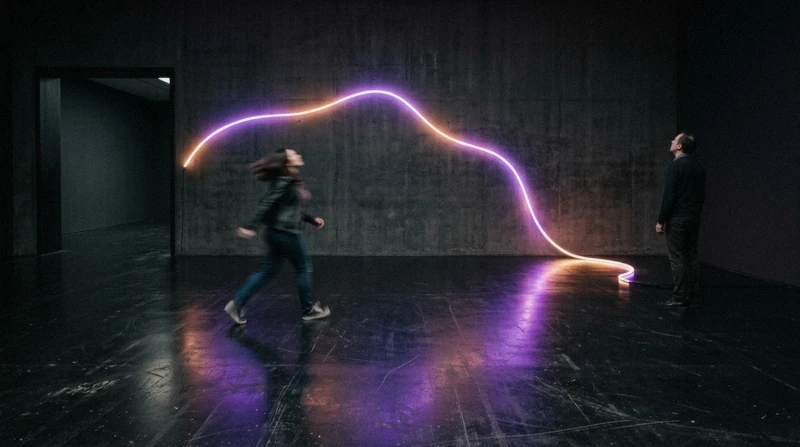
The concept is literal rather than poetic. Artworks are not installed in fixed positions: a light sculpture drifts out of one room, moves down a corridor and turns up somewhere else. Works meet each other and react, whether or not anyone is watching.
This is why the museum publishes no map and no facility pamphlet. There is nothing stable to draw. It is also why there are no artwork captions on the walls - instead, the teamLab app tells you about whichever work is nearest to you at that moment.
The practical consequence is that you cannot plan this visit and cannot tick things off. People routinely spend three hours here and leave having missed entire rooms, then find out later from someone else's photographs. If that idea irritates you rather than appeals to you, teamLab Planets - fixed route, delineated rooms, everything seen in order - is the museum you actually want.
What is showing now
The current exhibition is On the Asymmetry of the Universe, which introduced two new series.
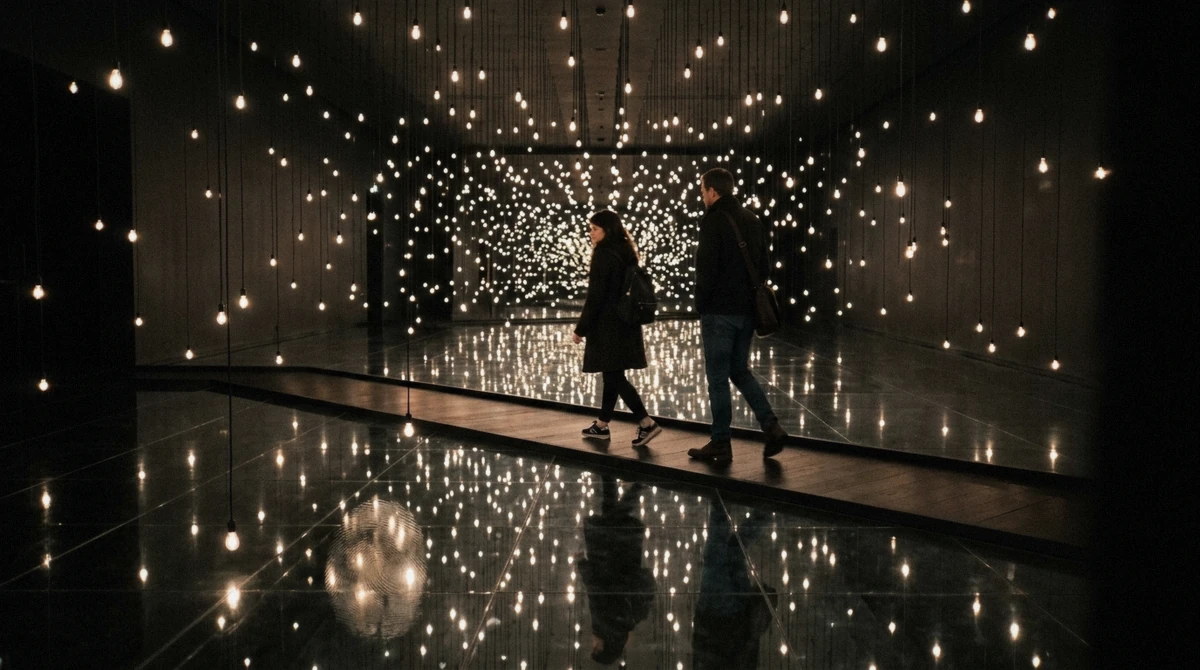
Asymmetric Existence is a single sculpture assembled from two light sculptures that should not be able to coexist: one appears in the physical room but casts nothing in the mirror, the other appears only inside the mirror and does not exist in the room. Standing between them is the point of the work.
Chromatic Existence makes a sculpture out of colour itself - colours flow through the space, and the order they fall into is the object.
Alongside these, seasonal works rotate through the year. Memory of Topography and Proliferating Immense Life - A Whole Year per Year were showing across June to August 2026. Because the programme changes, a walkthrough video filmed last year will show you rooms that may not be there on your date - useful for the feel, unreliable as a checklist.
teamLab Borderless Tickets: Prices, Passes and the Small Print
Dynamic pricing means no guide can quote you one number and be right. Here is the range and the rules around it.
What it costs
The museum quotes JPY 3,600 to 5,600 for adults aged 18 and over, moving by date. Teenagers 13 to 17 pay JPY 2,800, children 4 to 12 pay JPY 1,500, and children under 4 enter free.
Several guides still ranking for this museum print a flat "from 3,800 yen". That figure is not on the museum's own ticket page any more. If you are budgeting, use the top of the range for a weekend or a holiday and the bottom for a weekday outside peak season.
A limited Student Summer Pass exists for university, graduate, junior college and vocational students, valid for visits between 18 July and 18 September; outside that window students pay the adult rate.
Entrance Pass or Flexible Pass
An Entrance Pass has a fixed admission time. You turn up at the time on the ticket and join the entry line.
A Flexible Pass has no fixed time - come when you like on the date you booked, and queue on arrival. It is not unlimited freedom, though: last entry is one hour before the museum closes, and that applies to the Flexible Pass like everything else. Buying one for a day you might arrive at 20:45 with a 21:00 close does not work.
Whichever you hold, there is no limit on how long you stay after you are admitted, and you are never asked to leave before the next admission slot.
Buying on the day, and paying
Same-day tickets are possible if the slot has not sold out - through the official ticket site, or at the venue itself. The museum states plainly that on-site prices differ from online ones; the Tokyo Metropolitan Government's visitor page puts that gap at 200 yen.
The official site takes credit cards and PayPay. You never need to print anything: open the URL from the confirmation email and show the ticket screen at the entrance. If you have no smartphone, a print button appears 24 hours before your reservation date.
One genuinely useful feature for groups: from 24 hours before the date, tickets can be distributed to other people in your party using the share function on the ticket screen, so everyone can arrive separately at their own times. Sharing can be cancelled again if plans change. The exception is a disability-discount ticket - the certificate is checked at entry, so the holder and their companion must arrive together.
Changes, cancellations and what is not allowed
Tickets generally cannot be cancelled. What you can do - but only on tickets bought directly from the official ticket site - is move the date and time, up to three times.
The deadline is two hours before the reserved entry time on an Entrance Pass, or two hours before last entry on a Flexible Pass. Changes are refused once the ticket has been moved three times, if you are trying to switch to a different ticket type, if the new slot is sold out, or if you are trying to split a multi-ticket order across several dates.
You can move to a date with a different price: pay for the new slot and the original amount is refunded.
Buy from anywhere other than the official site - including the Klook admission ticket compared here - and the seller's own terms apply instead. Check them before you click, because they are not identical to the museum's.
Opening Hours and the Closing Days With No Pattern
The trap here is not the standard hours, it is the exceptions. Borderless closes on scattered Tuesdays and shifts its closing time by season, and none of it follows a weekly rule you could guess.
| teamLab Borderless | |
|---|---|
| Standard hours | 8:30 - 21:00 |
| Last entry | One hour before closing - 20:00 on a standard day |
| Late closing (22:00) | 8-15 August; 1-2, 5-9, 12-16, 19, 21-23, 26-30 October |
| Early closing (17:00) | 1 September |
| Closed entirely | Tue 25 August, Tue 8 September, Tue 20 October |
| EN TEA HOUSE | Opens 30 min after the museum, last orders 30 min before close |
| Time inside | Unlimited once admitted |
Read off the museum's own venue page on 20 August 2026. There is no "closed on Mondays" rule to fall back on - check your specific date on the official calendar before buying, especially if it is a Tuesday.
Inside: What There Is, and What There Is Not
A short list of things people assume a museum of this size will have, and which this one does not.
No re-entry, and no food
Re-entry is not permitted. Once you walk out, the ticket is finished. This matters more here than at most museums, because there is no cafe to duck into and reset: the museum has no restaurant and no cafe, only vending machines.
The exception is EN TEA HOUSE, and it is an artwork rather than a catering outlet - a digital flower blooms in the surface of your tea while you drink it, and blooms differently as the cup empties. It opens 30 minutes after the museum and takes last orders 30 minutes before closing. It is charged separately from admission.
So: eat before you come. Two to three hours in low light with no meal available inside is a long stretch on an empty stomach, and leaving to fix that costs you the ticket.
Crowds, queues and the waiting you did not book
During busy periods you may be asked to wait outside before entry, even holding a timed ticket, and admission itself can be capped when the museum is full.
The Azabudai Hills location softens this compared to Toyosu - both Kamiyacho and Roppongi-Itchome connect underground, so a queue is not a queue in the rain - but it does not remove it. The quietest run at a museum opening at 8:30 is the first hour, and the second-quietest is the last two hours on a late-closing October evening.
There is no rule about how long you may occupy a room, unlike Planets, where staff move people along at busy times.
Two rest areas, no nursing room
There are two rest areas in the museum and no nursing room - a real gap if you are visiting with a baby, and one worth planning around, because you cannot step out and come back.
Staff work in Japanese, English, Chinese in both simplified and traditional scripts, and Korean. On-site payment covers Visa, JCB, Mastercard, AMEX, UnionPay and Alipay.
If you are a Hills App member, scan the code at the information counter: a visit earns 50 points, up to three times a month.
The app is the only caption you get
Because the works move, nothing is labelled. The teamLab app fills that gap: it reads your position and tells you about the artwork nearest to you, which is the only way to leave knowing what you looked at.
Download it before you arrive rather than in the entrance queue. Once you are inside, a dark room is a bad place to be setting up an app, and the works you would most want named are the ones you meet in the first ten minutes, while you are still recalibrating to the light.
It also solves the problem of the exhibition programme changing. If you noted a work's name in the app, you can check later whether it is a permanent piece or part of a series like On the Asymmetry of the Universe that will eventually be replaced.
When to go, if you have a choice
The museum opens at 8:30, which is early for a Tokyo attraction and is the single best piece of timing information on this page. The first hour is the quietest the building gets, and the rooms that photograph best are the ones that work when they are not full of people.
The second window is the late one, but only on the dates when the museum closes at 22:00 rather than 21:00 - through 8-15 August and most of October. On those evenings, last entry moves to 21:00 and the final two hours thin out considerably.
What to avoid: a weekend afternoon in a school holiday, when dynamic pricing puts you at the top of the JPY 3,600-5,600 range and you may be asked to wait outside before entry. You pay the most for the most crowded version of the same museum.
teamLab Borderless or teamLab Planets?
The most-asked question about either museum, and the answer is not about which art is better.
The differences that actually decide it
At Borderless your shoes stay on, there is no water, there is no route, and the museum is permanent. At teamLab Planets you go barefoot, wade through water that reaches knee height on an adult, follow a fixed path through clearly separated rooms, and the whole venue closes at the end of 2027.
That is the choice. Both are teamLab, both are made of light, mirrors and projection, both put you inside the work rather than in front of it.
Pick Borderless if you want to wander, if you are travelling with anyone for whom bare feet on wet floors is a problem, if you are short on time in central Tokyo, or if you want the museum that will still be there in 2029. Pick Planets if the photographs that made you search for this in the first place had water in them - because those are all Planets.
Practical trade-offs nobody lists
Location. Borderless is in central Minato City, two minutes from a Hibiya Line exit, and connects to the station underground. Planets is in Toyosu, on the Yurikamome Line - reviewers describe it as an hour from the middle of Tokyo, and one August 2026 reviewer from Australia put it bluntly: Borderless is much more convenient.
Accessibility. Borderless admits wheelchairs, with some works excluded and a cap on how many are admitted at once. The Planets platform listing states outright that it is not suitable for wheelchair users.
Clothing. At Borderless, wear what you like - white or plain catches the projections best. At Planets, what you wear determines whether you enjoy the visit at all, because wet clothes are not allowed into the next artwork.
Time. Borderless gives you unlimited time and no route, so a visit stretches. Planets gives you unlimited time on a fixed path, so it compresses. If you have one free afternoon, Planets is the more predictable booking.
Is it worth the hype?
The recurring criticism of Borderless is not about the art - it is about expectations. People arrive having seen a specific room in a photograph, cannot find it, and leave feeling they missed the point. That is the design working as intended, and it is worth knowing before you pay.
The second complaint is queueing at peak times, which is real and is solved by going early rather than by paying more, since Borderless has no priority-entry product equivalent to the Planets Premium Pass.
What almost nobody complains about is the work itself. Reviewers who took a guided digital art museum tour consistently single out having someone explain what they were standing in - which is the strongest argument for the guided options if the no-map concept sounds more frustrating than freeing.
Getting to Azabudai Hills
Two stations, both connected underground, and a car park with a discount attached.
By train
The museum is on B1F of Azabudai Hills Garden Plaza B, at 1-2-4 Azabudai, Minato City.
It is two minutes on foot from Exit 5 of Kamiyacho Station on the Tokyo Metro Hibiya Line, or six minutes from Exit 4 of Roppongi-Itchome on the Namboku Line. Both stations connect to the building through an underground passage - follow the signs and you never come up to street level, which is worth something in August heat or November rain.
From Tokyo Station it is about 12 minutes: Marunouchi Line to Ginza, change to the Hibiya Line, off at Kamiyacho. From Shinjuku about 24 minutes via Kasumigaseki. From Haneda Airport roughly 30 minutes by train or 40 by limousine bus; from Narita about 45 minutes by train, 90 by bus.
By car, and the parking discount
Use the Azabudai Hills P6 car park, take the D elevator to B1, and the entrance to teamLab Borderless is immediately on your left.
If you bought your ticket online, present the parking ticket at the information counter for a discount. That is the museum's own instruction, and it is easy to miss because nothing at the car park mentions it.
Photography: The Rules, and Getting Anything Usable
Photography is welcomed here, within limits that exist because of how the works are lit.
What is allowed
Photographs and video are permitted, and so is posting them to social media.
Banned: flash, in any form - it wrecks the artwork for everyone in the room and the projections themselves. Also banned are tripods, monopods and selfie sticks 30 cm or longer, along with any other photographic support of that size, and commercial shooting without prior consent.
Media filming happens at the venue without notice; if you would rather not appear, tell a member of staff.
What actually works
The museum's own advice is the useful part: wear white or plain clothing, because it catches the projections and turns you into part of the work rather than a silhouette in front of it. Patterned clothing fights the light.
Beyond that, the rooms are dark and the works move, so a phone in night mode will produce blur where the work was moving - which is often more honest than a frozen frame. There are no captions to photograph for reference later, so if a work matters to you, note the name from the app while you are standing in it.
Accessibility, Children and Strollers
Borderless is the more accessible of the two teamLab museums, with three limits stated by the museum itself.
Wheelchairs
Wheelchairs can enter the premises. The museum names two constraints: some works cannot be experienced from a wheelchair for safety reasons, and the number of wheelchairs admitted at one time is capped, so you may be asked to wait. The museum asks that you call ahead for details rather than turning up and hoping.
The building itself is well set up - wheelchair loan, a wheelchair-accessible escalator, automatic doors, multi-purpose and ostomate restrooms, and diaper changing facilities. Compared with teamLab Planets, whose platform listing simply states it is not suitable for wheelchair users, this is a different level of provision.
Children and strollers
Strollers are not permitted inside. Leave them in the luggage room. In dark rooms with moving works and mirrored surfaces, this is not an arbitrary rule, but it does mean carrying a small child for two hours.
Children of elementary-school age and below cannot enter alone: one accompanying adult aged 18 or over per five such children, including any who enter free. teamLab Planets applies a stricter ratio of one adult per three children, which is worth remembering if you are planning both.
And the gap that catches families out: there is no nursing room, and there is no re-entry.
Where teamLab Borderless Is
Azabudai Hills, Minato City. Kamiyacho Station sits two minutes away on the Hibiya Line, connected to the building underground.
teamLab Borderless, B1F of Azabudai Hills Garden Plaza B.
teamLab Borderless: Questions Before You Book
How much are teamLab Borderless tickets?
Adults 18 and over pay JPY 3,600 to 5,600 depending on the date, because pricing is dynamic. Teenagers 13-17 pay JPY 2,800, children 4-12 pay JPY 1,500, and under-4s are free. The full breakdown, including the pass types, is above.
What is the difference between an Entrance Pass and a Flexible Pass?
An Entrance Pass has a fixed admission time. A Flexible Pass lets you arrive whenever you like on the booked date and queue on arrival - but it still cannot be used after last entry, one hour before closing. Neither limits how long you stay once inside.
Can I buy teamLab Borderless tickets at the door?
Yes, if the slot has not sold out - either at the venue or on the official site the same day. The museum states that on-site prices differ from online prices, and the Tokyo government's visitor page puts that difference at 200 yen. Slots do sell out, so booking ahead is both cheaper and safer.
Can I change my ticket date?
Only on tickets bought directly from the official ticket site, and up to three times - by two hours before your entry time on an Entrance Pass, or two hours before last entry on a Flexible Pass. You cannot switch ticket type, split a group order across dates, or move into a sold-out slot. Tickets bought elsewhere follow that seller's terms.
What is the best time to visit teamLab Borderless?
The first hour after the 8:30 opening, on a weekday outside a school holiday - it is the quietest the building gets and it is the cheap end of the dynamic price range. The second-best window is late evening on the dated nights when the museum runs to 22:00, through 8-15 August and most of October, when last entry moves to 21:00. The worst is a weekend afternoon in a holiday: top of the price range and the highest chance of being held outside before entry.
How long does it take to tour teamLab Borderless?
Two to three hours is normal, and there is no upper limit - the museum does not make you leave before the next admission slot. Because there is no map and works move between rooms, people regularly stay longer than planned and still miss things. If you want a fixed length instead, a guided pairing gives you exactly 1.5 hours inside with a guide, then a second Tokyo stop.
How long should I spend at teamLab Borderless?
There is no time limit once you are admitted, and no obligation to leave before the next admission slot. Two to three hours is normal, and because there is no map, people regularly stay longer and still miss rooms. Eat first - there is no restaurant inside.
Is there food inside teamLab Borderless?
No restaurant and no cafe, only vending machines. EN TEA HOUSE is an artwork you can drink in - a digital flower blooms in the tea - and it is charged separately, opening 30 minutes after the museum with last orders 30 minutes before close.
Which is better, teamLab Borderless or teamLab Planets?
They differ physically, not in quality. Borderless keeps your shoes on, has no route and no map, and is permanent. teamLab Planets is barefoot, involves wading through knee-deep water on a fixed path, and closes at the end of 2027. If the photographs that brought you here had water in them, you want Planets. Full comparison.
Do I need to print my ticket?
No. Open the link in your confirmation email and show the ticket screen at the entrance. If you have no smartphone or tablet, a print option appears 24 hours before your reservation date.
Can I share tickets with my group?
Yes, from 24 hours before the reserved date, using the share function on the ticket screen - so your group can enter separately at the times on their own tickets. Sharing can be cancelled again. Anyone accompanying a disability-discount ticket holder must arrive with them, as the certificate is checked at entry.
Is teamLab Borderless closing?
No. Its listed term is permanent, and it has been at Azabudai Hills since 9 February 2024. The closure date people have heard about belongs to teamLab Planets, which runs until the end of 2027 - a date already extended three times.
Can I bring a stroller?
No. Strollers are not permitted inside and must be left in the luggage room. There is also no nursing room and no re-entry, so plan a visit with a baby accordingly.
Does teamLab Borderless get busy, and can I skip the queue?
It does, and there is no priority-entry product here - nothing equivalent to the Premium Pass sold at teamLab Planets. During busy periods the museum may hold visitors outside before entry even with a timed ticket, and admission can be capped when the building is full. The fix is timing rather than money: the first hour after the 8:30 opening is the quietest, and on the dates when the museum runs until 22:00 the final two hours thin out as well.
What Visitors Say About Borderless
She showed me through the TeamLab experience and described all of the exhibits along the way. After that we walked to the Palace and gardens.
He took me to visit teamLab and the beautiful inner gardens of the Imperial Palace, making the whole tour interesting, enjoyable, and very well organized.
Loved it! Akira and Maya were great hosts - made sure our family experience was great and even took pics along the way.
Short excerpts from verified GetYourGuide reviews on the guided Borderless listings compared here, read in August 2026. First name, country and month as published.
Page last reviewed August 2026. Price, rating and review count read from the listing on August 2026. Prices, availability and terms are set by the operator and confirmed at checkout.
We may earn a commission if you book through one of our links, at no extra cost to you. Full affiliate disclosure