Digital Art Museum Tokyo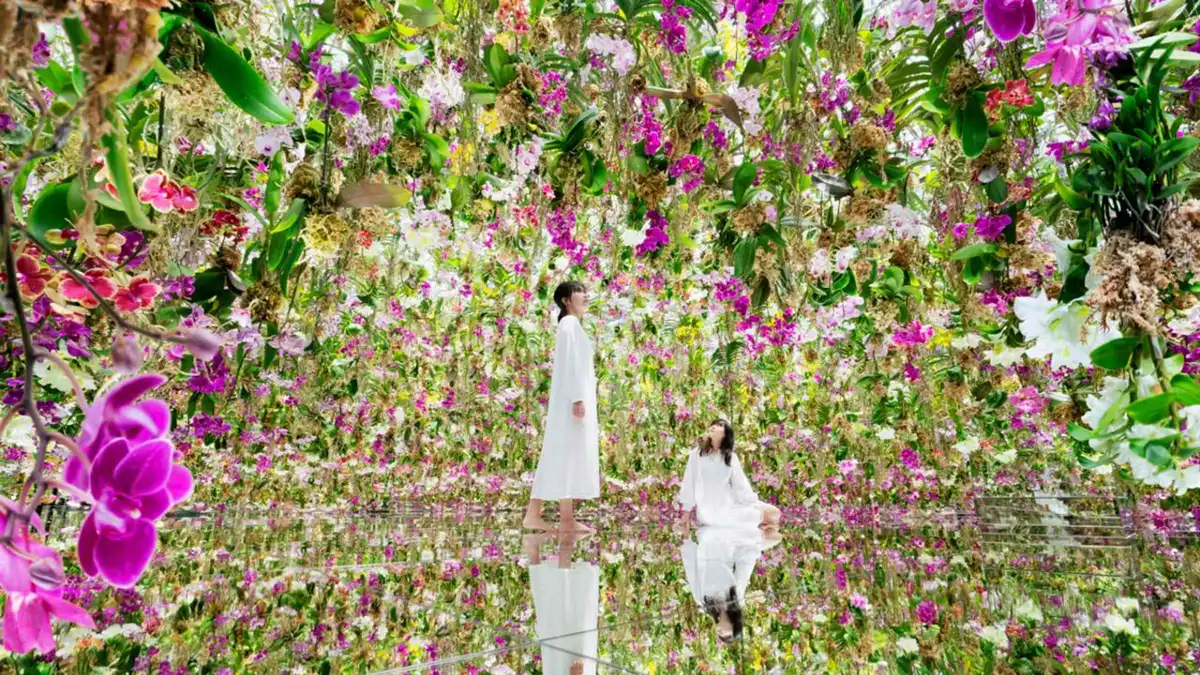
teamLab Planets TOKYO Digital Art Museum Entry Ticket
The Toyosu museum where you go barefoot and wade through the art. Pick an entry window, arrive within 30 minutes of it, then stay as long…
- Cancellation
- Non-refundable
- Operator
- LINKTIVITY Inc.
Tokyo has two teamLab venues answering to digital art museum Tokyo, they are 9 km apart, and the search phrase points at one while the best-selling ticket points at the other. One keeps your shoes on. The other puts you barefoot in water up to your knee. Sort out which is which before you book.
Updated August 2026
"Digital art museum Tokyo" is two museums, not one. teamLab Borderless at Azabudai Hills is officially named MORI Building DIGITAL ART MUSEUM, so the phrase belongs to it: shoes stay on, there is no map and no route, and admission runs on dynamic pricing from JPY 3,600. teamLab Planets in Toyosu is the one most people end up booking — its entry ticket is the best-selling digital art listing in Tokyo with 13,437 reviews — and there you go barefoot through water that reaches knee height. Neither museum allows re-entry, and both sell timed slots that sell out. The cheapest way in is the Planets entry ticket at around $23; the guided Borderless options cancel free up to 24 hours ahead.
Key takeaways
Four bookable options, two museums. Admission tickets let you stay as long as you like; the guided tours guarantee entry and put a guide beside you for 1.5 hours inside Borderless, then continue somewhere else. Booking, payment and cancellation are handled by the platform named on each card; prices, ratings and review counts here were read from the listings in August 2026.
The Toyosu museum where you go barefoot and wade through the art. Pick an entry window, arrive within 30 minutes of it, then stay as long…
The only way to buy Borderless admission on its own without a guided tour attached: teamLab sells tourist tickets through Klook. Adult admission is dynamically priced…
Ninety minutes inside Borderless with a guide who explains the works, then a walk to the Imperial Palace East Gardens and the Edo Castle stone walls…
Borderless first, then Roppongi Hills: Louise Bourgeois's Maman spider and 360-degree views over Tokyo Tower from the observation deck. Same operator and the same 1.5 hours…
The differences that decide your booking are in the last three columns. Everything else — the darkness, the mirrors, the projections, the fact that you become part of the work — the two museums share.
| Museum | Where | Shoes | Adult admission | Runs until | Book |
|---|---|---|---|---|---|
| teamLab Borderless | Azabudai Hills, Minato City | Stay on | JPY 3,600-5,600, dynamic | Permanent | Check Availability Details |
| teamLab Planets | Toyosu, Koto City | Off — barefoot | JPY 3,600 Entrance Pass | End of 2027 | Check Availability Details |
Both museums are indoors and run whatever the weather; only the Open-Air works at Planets close in a typhoon.
Borderless is officially MORI Building DIGITAL ART MUSEUM: teamLab Borderless — the name the search phrase comes from. It reopened at Azabudai Hills on 9 February 2024 after leaving Odaiba. Planets has been in Toyosu since 7 July 2018.
Live entry slots for the teamLab Planets ticket, straight from the booking platform. Entry windows fill from the outside in — the 08:00-12:00 and evening slots go last. Prices on this page were last read from the listings in August 2026.
Looking at Borderless instead? Borderless & Imperial Palace · Borderless & Roppongi Hills · teamLab Borderless ticket
Pick by what you want the visit to be: a physical experience you walk into, a wander with no map, or a fixed 90 minutes with someone explaining it.
That is teamLab Planets, in Toyosu. The koi swimming across the surface you are standing in, the room of orchids hanging above your head, the mirrored floor that turns a corridor of light into a shaft with no bottom — all Planets.
Buy the entry ticket, pick a window, and note the rule that catches people out: you may only enter in the first 30 minutes after the time on the voucher. Miss it and there is no refund. The listing also has no same-day tickets, so this is not a plan you can make at breakfast.
Once you are inside there is no time limit. Reviewers who booked the 16:30-18:30 window keep saying the same thing — they took their time and did not feel rushed. What you are buying at roughly $23 is admission, nothing else: no guide, no transport, no fast track past the queue.
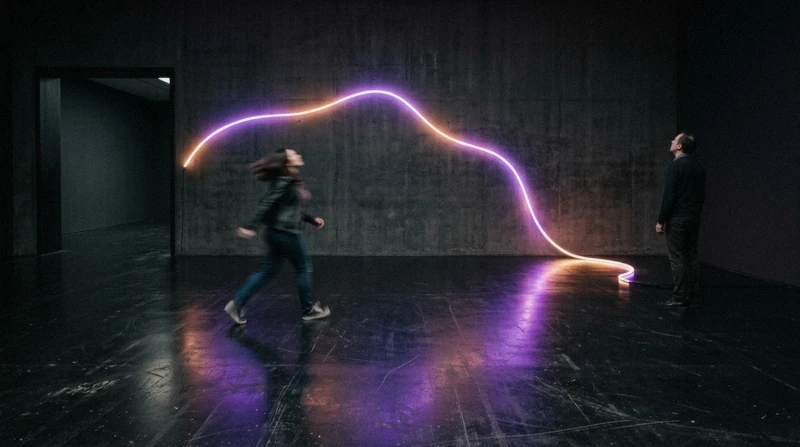
That is teamLab Borderless at Azabudai Hills, and the no-map part is deliberate rather than an oversight. The museum publishes no floor plan because the artworks physically move between rooms — a work you saw on one wall walks out of it while you watch. If you want to read what something is, the teamLab app tells you about the piece nearest to you.
The practical consequence: you cannot plan this visit and you cannot tick items off. People routinely spend three hours and leave having missed rooms. That is the intended experience, but if you like knowing what you paid for, Planets — with its fixed route through delineated spaces — will suit you better.
teamLab sells tourist admission for Borderless through Klook rather than through the general tour platforms, which is why this is the only standalone Borderless ticket on this page.
Then take one of the guided pairs. Both run three hours, both are private groups from the same operator, MARKEVISION, and both give you a guaranteed 1.5 hours inside Borderless with a guide who walks the rooms with you.
The Imperial Palace tour at about $118 puts the East Gardens and the Edo Castle stone walls after the museum — the deliberate contrast between the newest Tokyo and the oldest. The Roppongi Hills tour at about $141 goes the other way: Louise Bourgeois's Maman spider, then 360-degree views over Tokyo Tower from the observation deck.
Both are free to cancel until 24 hours before, and both let you reserve now and pay later. The trade you are making is money and time for context: 1.5 hours is a firm ceiling inside a museum that has no ceiling if you buy a ticket.
It works, but not in a lazy afternoon. Kamiyacho to Shin-Toyosu is about 35 minutes on the Hibiya and Yurikamome lines, and each museum wants two to three hours if you are not rushing.
The order that works: Borderless first, in the morning, since it opens at 8:30 and its rooms are calmest early. Planets later — it runs to 22:00, the light outside no longer matters once you are inside, and if your clothes end up damp you are heading home rather than to a second museum.
Doing them on separate days is better still. Neither allows re-entry, so a rushed lap is a lap you cannot repeat.
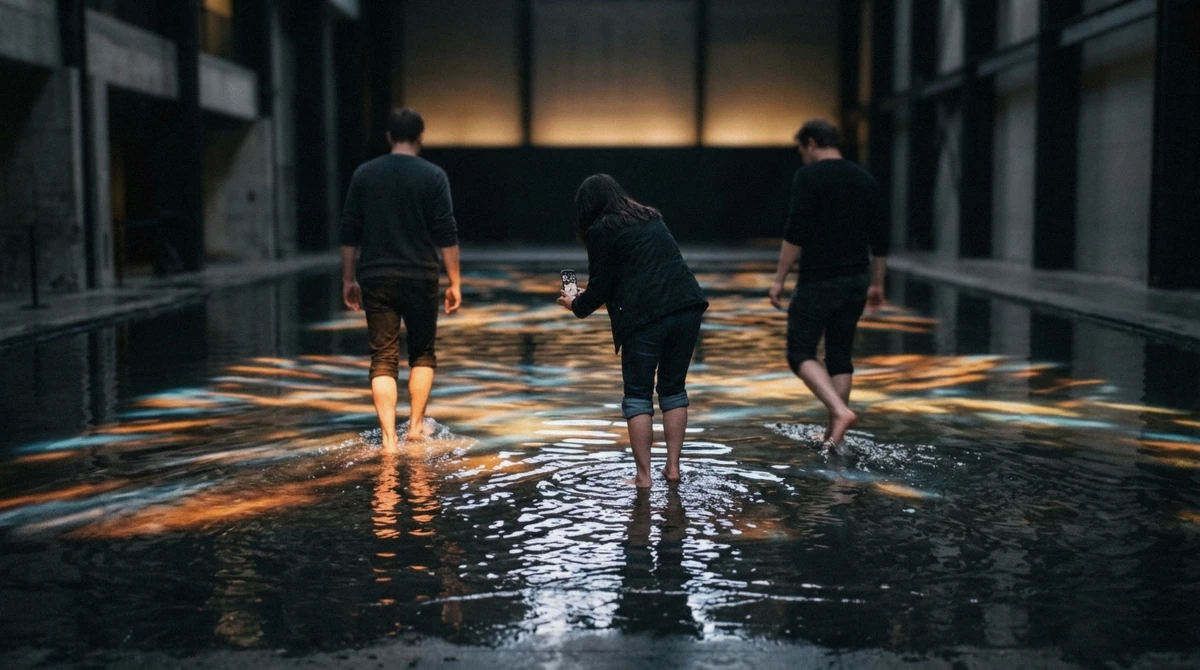
Both museums price dynamically, which is why no guide can give you one number and be right. Here are the ranges the museums themselves publish.
The official site quotes adults 18 and over at JPY 3,600 to 5,600, moving by date. Teenagers 13 to 17 pay JPY 2,800, children 4 to 12 pay JPY 1,500, and under-4s are free. Several guides ranking for this museum still print a flat "from 3,800 yen", which is a figure the museum's own page no longer shows.
There are two kinds of ticket. An Entrance Pass carries a fixed admission time. A Flexible Pass has none — you arrive when you like, queue on arrival, and the only hard limit is last entry, one hour before the museum closes.
You can buy on the day if it has not sold out — through the official ticket site, or at the venue itself, but the museum states plainly that on-site prices are different from online ones. The Tokyo Metropolitan Government's visitor page puts that gap at 200 yen. Either way the risk is the same: date and time slots do sell out, so booking ahead is the cheaper and safer move. The official site takes credit cards and PayPay, and you never need to print anything — the ticket screen on your phone is what gets scanned.
The Entrance Pass with a fixed admission time is JPY 3,600 for adults 18 and over, JPY 2,800 for junior and senior high school students, JPY 1,500 for children 4 to 12, and free for under-4s. Holders of a disability certificate pay JPY 1,800. All prices include tax and all move with dynamic pricing.
The Premium Pass at JPY 12,000 for anyone aged 4 and over does two things: it removes the fixed entry time and it gives priority entry. That is a lot of money for skipping a queue — but it is the only product either museum sells that addresses the complaint reviewers raise most often. One traveller from Australia, writing in August 2026, called the queue "very loooong" and said that on a hot, cold or wet day it tests your endurance before the art gets a chance to.
ID is checked. Bring a passport or ID card, and be ready to prove age or school affiliation if you booked a student ticket.
The Planets entry ticket compared here is sold by LINKTIVITY as an official ticket, at around $23 in August 2026. It is non-refundable — there is no late-arrival grace, no same-day purchase, and no refund if you miss your slot.
What it buys is a voucher in English, emailed to you, that you present at the door. What it does not buy is flexibility. If your Tokyo plans move around a lot, the museum's own site is the only place that lets you change a date, and even then only up to two hours before your admission time.
The Borderless ticket works the same way: teamLab's own conditions allow up to three date changes on tickets bought from the official ticket site, by two hours before entry. Buy anywhere else and you are bound by that seller's terms instead, which is worth checking before you click.
Neither museum permits re-entry, and neither refunds a ticket once you have entered. Planets tickets cannot be cancelled at all once bought.
Resale is banned outright at Planets, and a resold ticket will not get you in — the museum states plainly that it takes no responsibility for anyone turned away at the door with one. If a price on a resale site looks better than the museum's, that is the reason.
The guided tours are the exception to all of this. Both the Imperial Palace and Roppongi Hills tours are free to cancel up to 24 hours before the start time, with a full refund, and both let you reserve without paying today. If your dates are not firm, that flexibility is worth something real.
Both museums keep long hours and both shut on irregular dates that are announced venue by venue. These were read off the official pages in August 2026 — check again close to your visit, because they change.
| teamLab Borderless | teamLab Planets | |
|---|---|---|
| Standard hours | 8:30 - 21:00 | 8:00 - 22:00 |
| Last entry | One hour before closing | One hour before closing |
| Late closing | 22:00 on 8-15 Aug and most of October | Standard 22:00 daily |
| Early closing | 17:00 on 1 September | None listed |
| Closed days | Tue 25 Aug, Tue 8 Sep, Tue 20 Oct | Thu 3 Sep, Thu 1 Oct |
| Food inside | EN TEA HOUSE, opens 30 min after the museum | Vegan Ramen UZU, 10:30 - 21:30 |
Closing days at Borderless are irregular rather than weekly — there is no "closed on Mondays" rule to rely on. Both museums stop admitting one hour before the doors shut, so an 8pm arrival at Planets is fine and an 8pm arrival at Borderless is not.
No other Tokyo attraction has a dress code this consequential. Planets is the reason.
In the water works at Planets you walk barefoot. Shoes come off at the lockers, and socks or stockings come off too. Water levels rise to knee height even on adults — the museum says so in its own notes, and it is chlorinated with sodium hypochlorite to regulated levels. It is not a swimming pool and nobody is allowed to treat it as one.
Roll-up trousers, shorts or a skirt above the knee all work. Skinny jeans do not. If you turn up in something that cannot be rolled up, you are wading in it.
And here is the rule people find out too late: wet clothes are not allowed into the next artwork. Staff will stop you and ask you to change. If you have nothing to change into, you can rent a towel and dry off, but you are still standing in a corridor drying yourself instead of looking at art.
Several rooms at Planets have mirrored floors. The museum lends shorts for free in sizes XS to 6L, plus wraps, precisely for this — ask any member of staff and return them on the way out. If you are in a dress or a skirt and you would rather not think about it, this is the answer, and it costs nothing.
Footwear matters too. Sandals without heel support and heels do not work in some artworks; rental shoes are free as well. None of this is advertised at the door — you have to ask.
Borderless is the opposite: shoes stay on the whole way, there is no water, and the only clothing advice the museum gives is that white or plain clothing catches the projections better and that you will be walking a long way.
For small children, the museum recommends clothes you do not mind getting wet, or a spare set. There are diaper tables in the restrooms and a first-aid room if you need to feed or rest.
For yourself: a passport or ID card is required at Planets, lockers take small items, and the site has one area with strong flashing light and another that is genuinely dark.
Photography is allowed at both, and both ban flash. Borderless additionally bans tripods, monopods and selfie sticks 30 cm or longer, and commercial shooting without prior consent.
Half of this list exists because of the water at Planets. The Borderless column is short on purpose.
Free rental shorts at Planets run from XS to 6L and are returned on your way out. Ask staff — they are not offered automatically.
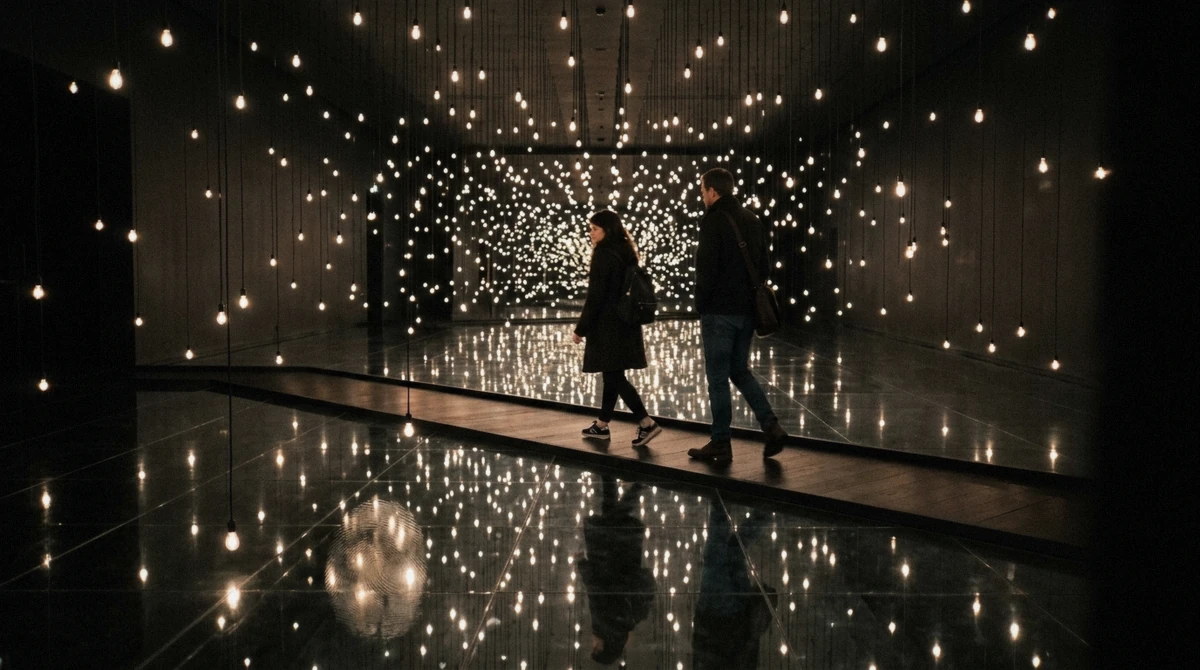
Both are made of light, mirrors and projection. What differs is how you move through them, and what the works are doing while you do.
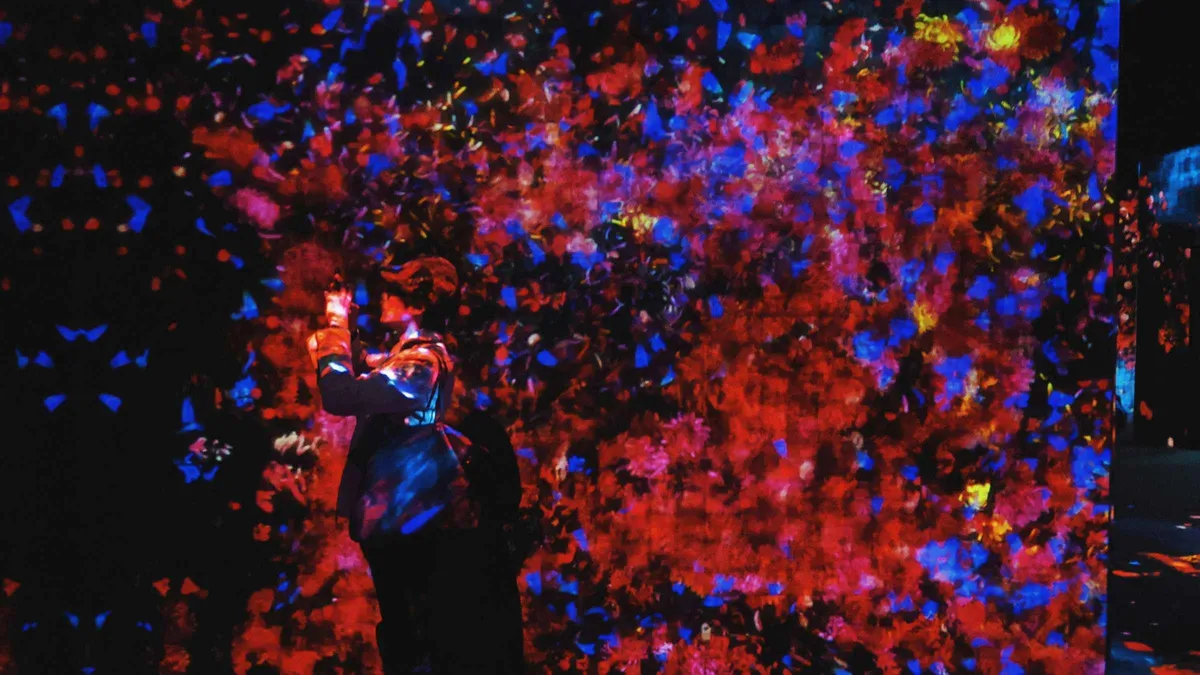
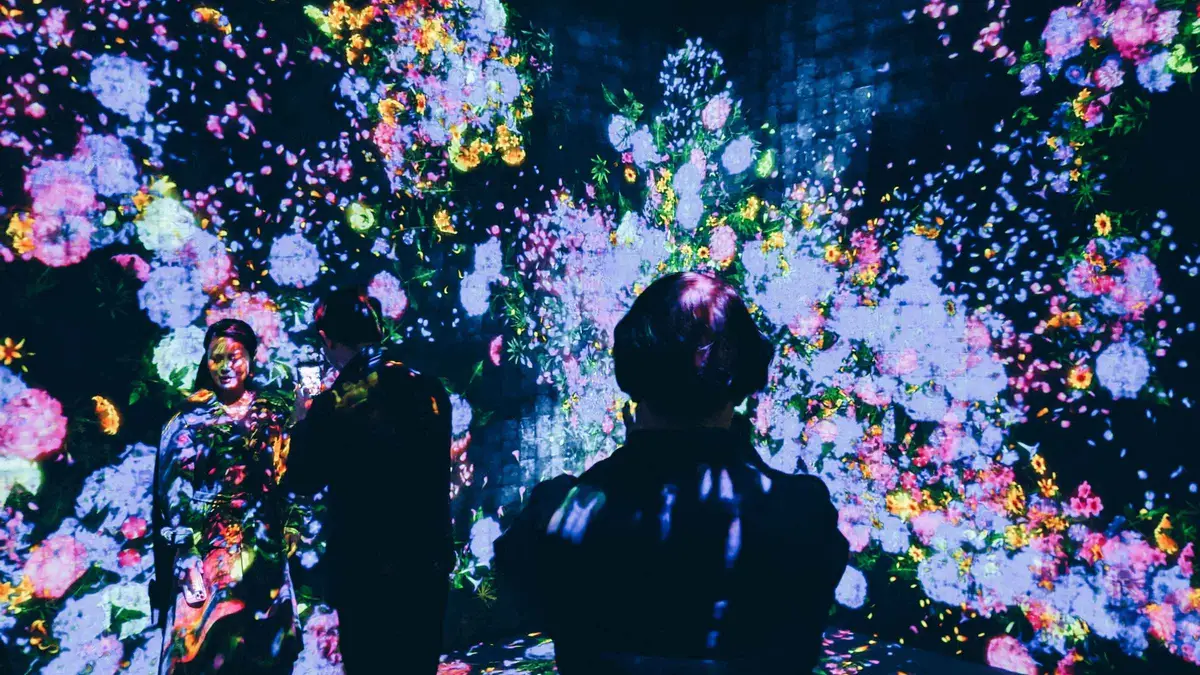
Drawing on the Water Surface Created by the Dance of Koi and People - Infinity is the one on every feed. Koi swim across the water you are standing in; when one collides with a person it bursts into flowers and scatters. The flowers change with the seasons, so the room is not the same in April as in November.
Floating Flower Garden fills a space entirely with living orchids that rise as you approach, opening a pocket of air around you. The orchids are real, growing without soil, absorbing water from the air — and if another visitor walks in, your two spaces merge into one.
Waterfall of Light Particles at the Top of an Incline sends light down a slope you climb. There is also a moss garden built around the fact that moss survives drying out completely and revives when wet, and a colour work using Kasane no Irome, the layered silk colours of pre-modern Japan, rendered in twelve shades of light.
The Open-Air section stays open in light rain. In typhoon winds or heavy rain it closes, and the rest of the museum carries on.
More than 75 works, over two floors, with the defining rule that they do not stay put. A light sculpture drifts out of one room and into the next; works meet each other and interact without you.
The current exhibition, On the Asymmetry of the Universe, introduced two new series. Asymmetric Existence is a single sculpture built from two light sculptures — one that exists only in real space and is not reflected in the mirror, and one that exists only inside the mirror and not in the room. Chromatic Existence makes a sculpture out of colours flowing through space and ordering themselves.
Seasonal works run alongside: Memory of Topography and Proliferating Immense Life - A Whole Year per Year were showing through June to August 2026.
There is an EN TEA HOUSE where a flower blooms in the surface of your tea while you drink it, opening 30 minutes after the museum and taking last orders 30 minutes before close.
Two museums, two ends of the city, and one bus route the museum itself is currently warning about.
The museum is on B1F of Azabudai Hills Garden Plaza B, 1-2-4 Azabudai, Minato City. It is two minutes on foot from Exit 5 of Kamiyacho Station on the Hibiya Line, or six minutes from Exit 4 of Roppongi-Itchome on the Namboku Line.
Both stations connect to the building through an underground passage, so you can follow the signs the whole way without surfacing — useful in rain and in August heat.
From Tokyo Station it is about 12 minutes: Marunouchi Line to Ginza, change to the Hibiya Line, off at Kamiyacho. From Shinjuku about 24 minutes via Kasumigaseki. From Haneda roughly 30 minutes by train; from Narita about 45.
Driving: use the Azabudai Hills P6 car park, take the D elevator to B1, and the entrance is immediately on your left. If you bought your ticket online, show your parking ticket at the information counter for a discount.
The address is Toyosu 6-1-16, Koto-ku. It is one minute on foot from the north exit of Shin-Toyosu Station on the Yurikamome Line, five minutes from Shijomae Station and Toyosu Market, and ten minutes from Exit 7 of Toyosu Station.
By taxi it is roughly ten minutes from Ginza and fifteen from Tokyo Station, and about fifteen minutes from Haneda by expressway.
One live warning from the museum: the To-05-2 Toei bus running from Tokyo Station, Ginza and Tsukiji towards Shin-Toyosu is currently heavily congested. If a journey planner offers you that bus, take the train instead.
Drivers get a small perk on weekdays. Show a same-day Planets ticket at Urban Dock LaLaport TOYOSU — 3F Card Desk or the 1F information centre — for one free hour of parking. The Toyosu Bayside Cross Tower lot is excluded.
The shape of a Planets visit, from the voucher on your phone to the door you cannot walk back through.
A guided Borderless tour compresses the middle of this into a fixed 1.5 hours and hands the queueing to the guide.
One museum has an end date, the other does not, and the difference matters if you are planning a trip a year out.
teamLab Planets TOKYO opened on 7 July 2018 and its published run ends at the end of 2027. That is the museum's own figure, printed on its venue details page.
It is also a date that has already moved three times. The original plan closed the museum at the end of 2022. It was extended to the end of 2023. Then it was extended again, to the end of 2027. Nothing about the previous extensions was announced far in advance, and nothing announced so far suggests a fourth.
The practical answer: if you are in Tokyo before the end of 2027, Planets is open and you do not need to rush. If you are planning for 2028, do not build an itinerary around it until teamLab says something.
Borderless is permanent at Azabudai Hills. It opened there on 9 February 2024, and the venue's own listing gives its term as "Feb 09, 2024 - Permanent".
What does change is what is inside. The museum rotates exhibitions and adds series — On the Asymmetry of the Universe is the current one, and seasonal works come and go through the year. If you visited the old Odaiba site before it closed, this is not the same museum rebuilt; the works and the building are different.
The name confusion is not your fault. Three separate entities share one word.
teamLab is the art collective — a group of artists, programmers, engineers and animators who make the works. They are the authors, not a venue.
MORI Building is a Tokyo property developer. It built Azabudai Hills, it co-produces the museum, and its name is in the official title MORI Building DIGITAL ART MUSEUM: teamLab Borderless. That is why the phrase "Mori digital art museum Tokyo" gets searched at all.
Mori Art Museum is a different institution entirely: a contemporary art museum on the 53rd floor of Mori Tower in Roppongi Hills, with its own curators and its own exhibitions, none of which are teamLab. You can visit it on the same day as Borderless — Roppongi Hills is a short walk from Azabudai Hills, and the Roppongi skyline tour covers that ground — but it is not the digital art museum you were looking for.
One more: the Odaiba venue that closed in 2022 was also called MORI Building DIGITAL ART MUSEUM: teamLab Borderless. Old articles pointing you to Odaiba are describing a building that no longer houses it.
The two museums differ sharply here, and the platform listing and the museum's own page do not say quite the same thing.
Borderless is the accessible one. It is wheelchair accessible, loans wheelchairs at the venue, and has a wheelchair-accessible escalator, multi-purpose and ostomate restrooms, automatic doors and diaper changing facilities. Two caveats the museum states itself: a few works cannot be experienced from a wheelchair for safety reasons, and the number of wheelchairs admitted at once is capped, so you may be asked to wait. Strollers are not allowed inside at all — they go in the luggage room. Staff work in Japanese, English, Chinese in both scripts, and Korean.
Planets is harder. The GetYourGuide listing states plainly that the experience is not suitable for wheelchair users, along with people with heart conditions and people with epilepsy — the museum has an area of strong stimulating light and another that is dark. The museum's own notes are gentler: they describe detour routes for visitors with disabilities and for anyone travelling with children who wants to skip a particular artwork, arranged by staff on request.
Both things can be true — a route exists, but barefoot passage through water on mirrored floors is not a level access. If mobility is a factor, Borderless is the museum that was built for it.
At Planets, one accompanying adult is required for every three children, counting the under-4s who enter free. Borderless sets its own ratio: one adult aged 18 or over for every five children of elementary-school age or below, who cannot enter alone. The booking listing adds that children under 13 must be accompanied by an adult, and unaccompanied minors are not admitted.
For safety reasons, pregnant visitors are not permitted in some areas of Planets. Staff will route you around them.
Infants can come in a front baby carrier. There are diaper tables in the restrooms and a first-aid room for feeding or resting. Borderless, by contrast, has two rest areas but no nursing room at all — worth knowing before you plan a long visit with a baby.
Still photographs from either museum are lit by the artwork itself, which flatters everything. Film is harder to flatter — and it shows you the two things stills cannot: how dark the rooms actually are, and how much of the visit is walking.
The whole Toyosu route in order, including the locker area where shoes come off and the water rooms at their real brightness.
Video: Tomodachi Ken in JapanA practical guide to the Azabudai Hills museum — the no-map problem, the app, and how people actually move through rooms that have no route.
Video: Tokyo KenchanUnhurried and unnarrated. The clearest look at how one artwork leaves a room and turns up in the next.
Video: VIRTUAL JAPANThird-party videos, embedded from YouTube. Exhibitions rotate, so a room in a 2025 film may not be showing on your date.
The combination of immersive digital art, water, mirrors, lights and nature creates something completely unlike a typical museum. You're genuinely part of the artwork rather than just looking at it.
Well money spent. My teenage boys all had fun including the adults. It was a different experience than what we expected.
He took me to visit teamLab and the inner gardens of the Imperial Palace, making the whole tour interesting and very well organized.
She showed me through the TeamLab experience and described all of the exhibits along the way. After that we walked to the Palace and gardens.
A superb experience. A wonderful and magical world. Total immersion and stimulation of all our senses.
Great museum, very surprising. Very inventive and magical, with great photo opportunities. A must-see.
Short excerpts from verified GetYourGuide reviews on the listings compared here, read in August 2026. Reviewer first name, country and review month as published.
There are two, both by the art collective teamLab. teamLab Borderless at Azabudai Hills is officially MORI Building DIGITAL ART MUSEUM, and teamLab Planets sits in Toyosu, about 9 km away. Borderless has no map and keeps your shoes on; Planets is barefoot and involves walking through water.
Neither is better; they answer different questions. Planets is the physical one — water to knee height, orchids overhead, a fixed route — and it holds the best-selling entry ticket with 13,437 reviews. Borderless is the exploratory one: 75+ works that move between rooms, no floor plan, and full wheelchair access. If you only have time for one and you have seen the koi-and-water photographs, you want Planets.
teamLab Planets is scheduled to run until the end of 2027. That date has already been extended three times — first from 2022, then from 2023 — so another extension is possible but has not been announced. Borderless is permanent and has no end date.
No. Mori Art Museum is a contemporary art museum on the 53rd floor of Mori Tower in Roppongi Hills, with no connection to teamLab's work. The "MORI Building" in the Borderless name is the property developer that built Azabudai Hills. The three names untangled.
Both museums use dynamic pricing. Borderless quotes adults 18+ within a published range, with lower rates for teenagers and children and free entry under 4. Planets prices its adult Entrance Pass at a fixed tier with a much more expensive Premium Pass that skips the queue. The current figures for both, and what the platform tickets add, are set out here.
Yes, in the water works — shoes, socks and stockings all come off at the lockers. Water reaches knee height on adults, and wet clothes are not allowed into the next artwork, so bring something that rolls up or a change of clothes. Full clothing guidance.
Yes, but allow two to three hours each and about 35 minutes between Kamiyacho and Shin-Toyosu. Borderless first works better — it opens at 8:30 and is quietest early, while Planets runs to 22:00. Neither museum allows re-entry, so a rushed lap cannot be repeated.
At Planets, entry is only possible within the first 30 minutes after the time on your voucher, and the entry ticket gives no refund for late arrival. The museum's own site says you can still enter later the same day within opening hours if you speak to staff — but that is the museum's position, not the platform's refund policy.
They buy you context and a guaranteed slot, not more time. Both the Imperial Palace tour and the Roppongi Hills tour give a fixed 1.5 hours inside Borderless with a guide, then a second Tokyo stop, and both cancel free up to 24 hours ahead. A plain ticket costs far less and has no time limit at all.
Yes, at both museums, and posting to social media is fine. Flash is banned everywhere. Borderless also bans tripods, monopods and selfie sticks 30 cm or longer, and any commercial shooting without prior consent.
Plan the visit
The two museums, the practical rules and the questions people ask after they have decided to go.